The MANZANILLA from Sanlúcar de Barrameda, the wine of joy

In Sanlúcar de Barrameda, where the Guadalquivir River meets the Atlantic, a wine is born that cannot be made anywhere else in the world. It is called Manzanilla, and its history is the story of an entire city.
There are wines that are crafted. And there are wines that simply happen. Manzanilla belongs to this second category, that lineage of gastronomic miracles that depend as much on human skill as on a handful of variables that no one fully controls: the humidity rising from the estuary, the salty breeze that blows in the afternoons, the mild temperature that rarely soars. Taking a cask of Manzanilla from the cellars of Sanlúcar and aging it in Jerez, barely twenty kilometers inland, is enough for the wine to change its character. The people of Sanlúcar have been repeating it for centuries as an axiom: Manzanilla is only Manzanilla in Sanlúcar.
A happy accident turned into a tradition
Like so many great wines, Manzanilla was born more out of necessity than design. For centuries, Sanlúcar was the port of departure for the Indies—Magellan set sail from here in 1519—and also a storage and stopover point for the wines produced in the Jerez region. The cellars along the river, with their constant humidity from the ocean, proved to be the perfect habitat for a phenomenon that winemakers would take generations to fully understand: the spontaneous appearance of a layer of yeast on the surface of the wine, a whitish blanket that the people of Sanlúcar affectionately christened, with almost domestic warmth, "flor."
That veil is not a defect or a passing accident: it is the soul of the wine. It feeds on alcohol and glycerin, protects the wine from direct contact with oxygen, and, over the months, imparts that sharp, saline, and slightly bitter profile—almond, chamomile, saltpeter—that has made this unique fino famous throughout the world.

The system of concrete slabs: a living library
Manzanilla is aged using the traditional "criaderas and solera" system, a system of stacked barrels where the youngest wine is added from the top and the oldest is gradually drawn from the bottom row—the solera—for bottling. A barrel is never completely emptied: there is always a remnant that imparts character to the new wine that arrives. It is, in a way, a liquid memory: each bottle of Manzanilla contains traces of wines made decades ago, some of which have since disappeared in any other form.
Centuries-old wineries like Barbadillo, La Guita, Hidalgo, and Delgado Zuleta have maintained this system generation after generation, often within the same family. Their cathedrals of casks—towering, dimly lit, with that unmistakable scent of old wood and saltpeter—are now pilgrimage destinations for wine enthusiasts from all over the world, and several of them open their doors for guided tours that invariably end with a glass served "en rama," straight from the wine with minimal filtration.

Designation of Origin and local pride
In 1964, Manzanilla obtained its own Designation of Origin, separate from that of Jerez-Xérès-Sherry, a belated but well-deserved recognition of its unique character. Today, the Manzanilla-Sanlúcar de Barrameda DO exclusively protects wines produced within the municipality, a legal gesture that merely confirms what the people of Sanlúcar have always known: that this wine is, above all, a product of its place, almost as unique as an accent.
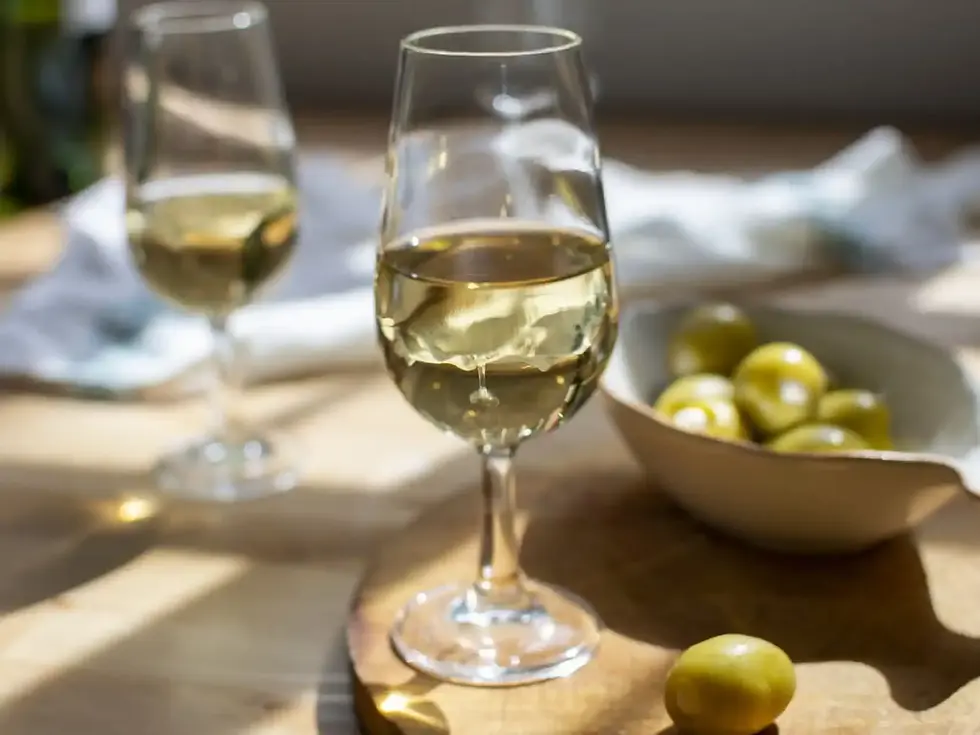
The city has turned that pride into a celebration. Every May, the Manzanilla Fair fills the Real del Pino fairgrounds with booths where the wine flows freely, served in the classic "catavino," the narrow, elongated glass designed to preserve its aroma. And in August, the famous horse races on the beach—another centuries-old tradition, declared a Festival of International Tourist Interest—are unthinkable without a glass of chilled Manzanilla in the hands of the spectators, sand and wine sharing the same shoreline.

A wine for the table, not for the occasion
Unlike other fortified wines associated with formal toasts, Manzanilla has earned the status of an everyday wine in Sanlúcar: it accompanies mid-morning aperitifs, tapas of prawns and sea anemones, and fried fish at any beach bar on Bajo de Guía beach. It's served chilled, almost ice-cold, in small glasses that invite you to refill them again and again, and it's best enjoyed young, because once the bottle is opened, the flor disappears and the wine begins to lose its charm within days.
That direct relationship between wine and daily life in the city is perhaps what best explains its longevity. Manzanilla isn't a wine saved for special occasions: it's a wine that transforms any moment—a Sunday afternoon, a chat at a downtown bar—into a special occasion. That has been its true secret for centuries.


Comments